


 English
 中文简体
中文简体In many forming environments, material behavior does not stay constant once processing begins. It shifts slightly under pressure, movement, and surface contact. These shifts are not always visible at the beginning, but they tend to show up later when consistency is required across repeated operations.
In continuous production, small differences can travel through the entire line. A strip that enters the system in a stable condition may still behave differently once it is under tension or bending force. The way it reacts is often shaped earlier than expected, sometimes during handling or intermediate processing steps.
What matters is not only the material itself, but how it behaves while being guided, cut, and formed. That behavior becomes the reference point for all later stages.
How Carbon Steel Strip Thickness Variation Influences Forming Consistency in Real Production
Thickness variation is often treated as a small detail, but in forming environments it can shift how force is distributed. When material thickness is not fully aligned across its width or length, the response during shaping becomes slightly uneven.
In practical operation, this does not appear as a sudden issue. It usually starts as subtle differences in bending resistance. Over time, these small changes affect how the formed shape settles.
A few common behaviors can be noticed:
- The material may respond differently under the same pressure level
- Some sections may recover slightly more after forming
- Tool contact feels less uniform during repeated cycles
These effects are not isolated. They tend to interact as the strip moves through multiple stages.
| Thickness Behavior | Process Response | Practical Observation |
|---|---|---|
| Stable condition | Smooth forming | Shape remains steady across cycles |
| Slight variation | Mild resistance shift | Adjustment appears during operation |
| Irregular spread | Uneven forming | Local deformation becomes noticeable |
In continuous systems, even small variation in Carbon Steel Strip thickness can gradually influence overall stability, especially when the same forming motion is repeated many times.
Why Edge Quality of Carbon Steel Strip Changes Downstream Processing Behavior in Stamping Lines
Edge condition is often overlooked initially since it does not directly influence the central area of the material. However, in feeding and stamping systems, edges are the initial contact points. That makes them more influential than they appear.
When edge geometry is not smooth, interaction with guiding elements becomes less predictable. The strip may still move forward, but its path can feel less controlled.
This can appear in several ways:
- Slight deviation during feeding alignment
- Increased sensitivity in guiding channels
- Uneven wear patterns on contact surfaces
Instead of a single failure point, edge condition tends to influence small interactions along the way. These interactions accumulate during continuous operation.
A Carbon Steel Strip with more stable edge formation usually behaves in a more consistent way during movement, especially when feeding speed is steady and repeated cycles are involved.
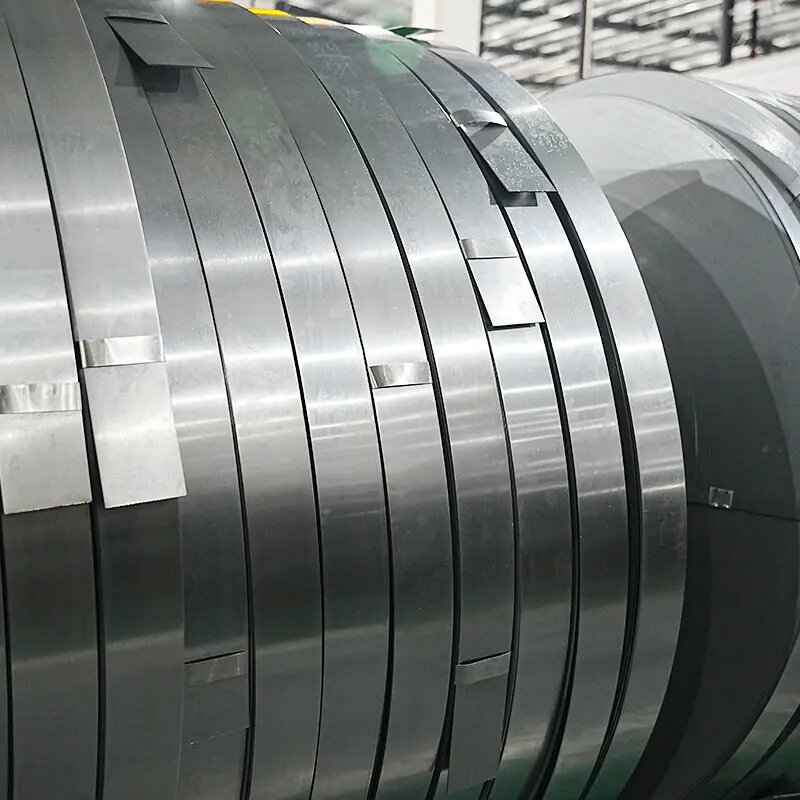
How Internal Stress in Carbon Steel Strip Develops During Slitting and Coil Handling Processes
Internal stress does not appear at the surface. It builds inside the material structure during shaping, cutting, and winding stages. Once formed, it stays hidden until the strip is released into a flat or tensioned state.
When the coil is opened, the stored imbalance can express itself in different ways. The material may not lie perfectly flat. It may shift slightly as it moves forward. These are not defects in a strict sense, but responses to earlier mechanical history.
Typical observations include:
- Slight curvature appearing after unwinding
- Edge movement that changes alignment
- Uneven relaxation during initial feeding
The origin of these behaviors is usually connected to earlier handling steps such as slitting or tight winding. Even small differences in handling pressure can influence how stress is distributed inside the coil.
In practice, Carbon Steel Strip behavior at this stage often reflects what happened before it even reached the forming line.
When Carbon Steel Strip Requires Surface Treatment to Maintain Stable Processing Performance
Surface condition changes gradually depending on storage, exposure, and handling contact. These changes may not always be visible, but they can affect how the material interacts with tools and processing environments.
In forming and coating operations, surface behavior influences how smoothly contact occurs. If the surface condition shifts, friction response can also shift slightly.
This can result in:
- Changes in movement smoothness during feeding
- Variation in coating or bonding behavior
- Slight inconsistency in tool contact feel
Surface treatment becomes relevant when these changes begin to affect process stability rather than appearance alone. It is often considered as part of maintaining consistent interaction rather than modifying the material itself.
A Carbon Steel Strip with controlled surface condition tends to maintain more predictable interaction across repeated processing cycles.
Which Factors Affect Springback Behavior of Carbon Steel Strip After Bending Operations
Springback often shows up after the forming stage seems finished. At the moment pressure is removed, the shape does not always stay exactly where it was set. A slight return movement can appear, sometimes small enough to be missed unless parts are compared side by side.
In practical lines, this behavior is not always consistent. Some pieces hold their shape more firmly, while others shift slightly after release. The difference is usually subtle at first.
What tends to be observed:
- Small opening changes in bent angles after unloading
- Uneven recovery between similar parts
- Slight mismatch between formed shape and final resting shape
These reactions are not always linked to a single cause. They often come from how deformation was distributed during bending. When force is not fully uniform, the stored response inside the material also becomes uneven.
| Bending Condition | Observed Response | Practical Behavior |
|---|---|---|
| Stable forming | Mild recovery | Shape stays close to target |
| Moderate variation | Noticeable return | Adjustment appears after release |
| Uneven forming | Irregular springback | Final shape needs correction |
In production, Carbon Steel Strip behavior during springback is often checked indirectly through final alignment rather than during forming itself.
How Carbon Steel Strip Tension Control Affects Accuracy in Continuous Manufacturing Systems
Tension is one of those factors that is easy to ignore during normal operation because the movement still looks smooth. But inside continuous systems, it quietly influences how the strip behaves from entry to exit.
When tension is slightly off balance, the material does not always react immediately. The effect builds gradually along the line.
Typical signs include:
- Small drifting in feeding alignment
- Slight variation in spacing between formed sections
- Uneven movement at guide contact points
In some cases, the strip still completes the process, but the stability feels less steady than expected. Operators often notice it only after repeated cycles.
Carbon Steel Strip under stable tension tends to move with fewer corrections needed during guiding stages, especially when the line runs continuously without interruption.
Tips for Selecting Carbon Steel Strip for Components That Require Consistent Dimensional Behavior
Selection is not usually a single-step decision. It often involves matching how the material behaves with how the process is structured. In real production, dimensional stability depends on more than one factor acting together.
Instead of focusing only on specifications, attention is often placed on how the strip behaves during actual movement.
Common practical checks:
- How smoothly it feeds through guiding paths
- Whether bending response feels consistent across sections
- If surface contact remains steady during repeated cycles
Sometimes small differences in behavior matter more than expected. A material that feels slightly more stable during early setup often reduces adjustment later in production.
Carbon Steel Strip used in dimensional-sensitive components is usually chosen based on overall response consistency rather than isolated properties.
Across forming, edge contact, internal movement, surface interaction, and tension behavior, strip performance does not stay isolated in separate steps. Each stage leaves behind a small influence that shows up later in a different form.
Instead of treating each process as independent, production stability is often shaped by how smoothly the material passes through transitions. When those transitions remain predictable, the overall system tends to require fewer corrections during operation.


